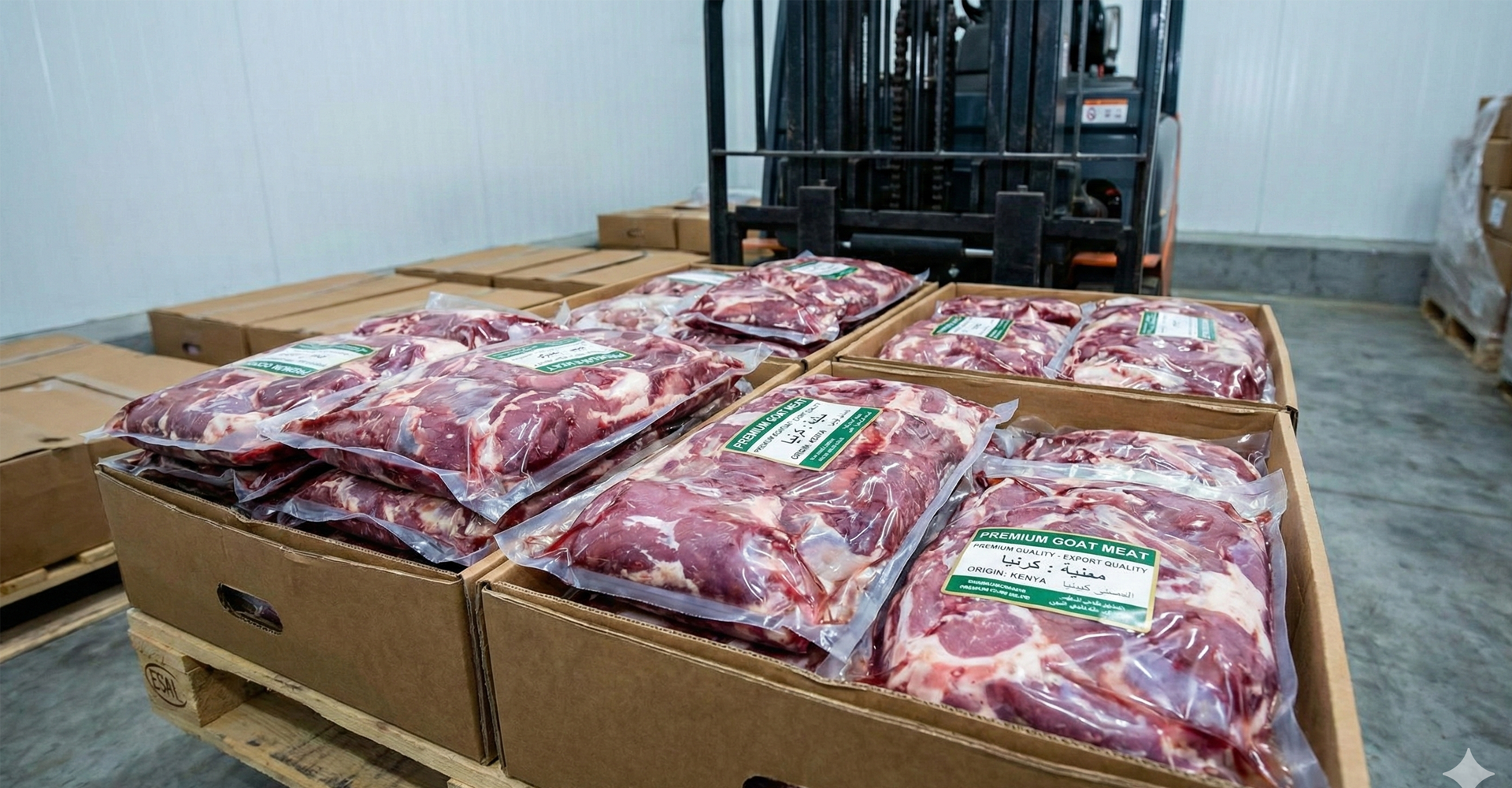
Kenya is rapidly emerging as a key player in the global goat meat export market. With rising international demand for halal goat meat, strong livestock numbers, and strategic access to the Middle East and African markets, goat meat export in Kenya presents a highly profitable agribusiness opportunity.
This article explores Kenya’s goat meat export industry, market statistics, export destinations, requirements, challenges, and future growth potential.
Overview of Goat Meat Production in Kenya
Kenya has one of the largest goat populations in Africa, estimated at over 34 million goats, predominantly reared in arid and semi-arid lands (ASALs) such as Turkana, Garissa, Isiolo, Marsabit, Kajiado, and Tana River.
Goat farming is favored due to:
- High adaptability to harsh climates
- Low production costs
- Strong cultural and commercial demand
- Fast reproduction cycles
These factors make Kenya highly competitive in the international chevon (goat meat) trade.
Why Goat Meat Export Is Growing in Kenya
1. Rising Global Demand for Goat Meat
Goat meat is increasingly preferred due to its:
- Low fat and cholesterol content
- High protein value
- Cultural and religious acceptance
Demand is especially strong in the Middle East, North Africa, and parts of Asia.
2. Halal Certification Advantage
Kenya’s export system supports halal-certified goat meat, a key requirement for markets such as:
- United Arab Emirates (UAE)
- Saudi Arabia
- Qatar
- Kuwait
- Bahrain
- Oman
This gives Kenyan exporters a strong competitive edge.
3. Strategic Location and Logistics
Kenya’s proximity to Gulf countries allows for:
- Short transit times
- Lower freight costs
- Export of both fresh and frozen goat meat
Kenya Goat Meat Export Statistics
Kenya’s goat and sheep meat exports have recorded consistent year-on-year growth.
- Export value exceeded USD 120 million in recent years
- Goat meat exports increased by over 40% year-on-year
- UAE accounts for nearly 60% of Kenya’s goat meat exports
Major Export Destinations
- United Arab Emirates
- Saudi Arabia
- Kuwait
- Bahrain
- Oman
- Somalia
- Democratic Republic of Congo
- South Sudan
Goat Meat Export Requirements in Kenya
To legally export goat meat from Kenya, exporters must comply with the following:
1. Veterinary and Health Certification
- Disease-free certification
- Meat inspection approval
- Compliance with importing country standards
2. Halal Certification
Mandatory for Middle Eastern markets, issued by approved Islamic bodies.
3. Licensed Slaughter Facilities
Goat meat must be processed in export-approved abattoirs with:
- Cold-chain systems
- Traceability mechanisms
- Hygiene and quality controls
4. Export Documentation
- Export permit
- Certificate of origin
- Health and phytosanitary certificates
- Customs clearance documents
Opportunities in Goat Meat Export Business
1. Value Addition
Exporters can earn higher margins by supplying:
- Vacuum-packed goat meat
- Portion-controlled cuts
- Ready-to-cook and frozen products
2. AfCFTA Market Access
The African Continental Free Trade Area (AfCFTA) opens new regional markets across:
- West Africa
- Central Africa
- Southern Africa
3. Contract Farming and Aggregation
Linking pastoral farmers with exporters through:
- Guaranteed pricing
- Aggregation centers
- Feedlot finishing systems
This ensures quality consistency and steady supply.
Challenges Facing Goat Meat Export in Kenya
Despite strong potential, the sector faces challenges:
- Climate change and recurrent droughts
- Livestock disease outbreaks
- Limited cold-chain infrastructure
- Inconsistent quality from informal production systems
However, ongoing government and private-sector investments are addressing these gaps.
Future Outlook of Goat Meat Export in Kenya
The future of goat meat export from Kenya is highly promising. With:
- Improved livestock genetics
- Expanded processing capacity
- Strong demand from Gulf and African markets
- Supportive export policies
Kenya is well-positioned to become a leading goat meat exporter in Africa.
For investors, agribusiness entrepreneurs, and livestock producers, goat meat export offers a scalable, sustainable, and high-return opportunity.
Conclusion
Goat meat export in Kenya is no longer a niche trade — it is a fast-growing agribusiness sector with significant economic impact. By focusing on quality, certification, value addition, and market diversification, Kenyan exporters can dominate regional and global markets.
Whether you are a farmer, exporter, investor, or agribusiness consultant, now is the ideal time to explore Kenya’s goat meat export value chain.
SEO Keyword Focus Used
- Goat meat export in Kenya
- Kenya goat meat export
- Goat meat exporters in Kenya
- Halal goat meat Kenya
- Chevon export Kenya
- Livestock export Kenya
